
Resources · Website Maintenance
What Website Maintenance Costs
By Seth Aho · August 5, 2026 · 7 min read
I charge $45 a month. That covers hosting, monitoring, backups and up to 10 small content updates per quarter.
You can stop reading there if that was the whole question.
If you went looking for that number before you got here, you probably noticed how hard it is to find. Search for what website maintenance costs and the answers are ranges wide enough to be useless. It depends on your needs.
There is a reason for that. Almost everyone publishing an answer sells the service, and a wide range keeps the conversation open until they know what you can pay. I am not going to pretend I have a survey of what the market charges. The published figures I could point you at all come from companies quoting their own rates, and I am not treating a sales page as data.
What I can do is tell you my number and show you what it covers. Then I can explain what makes the same service cost five times more somewhere else.
What you are actually paying for
Website maintenance isn’t one job. It’s six, sold under one name. Pulling them apart is most of the work of comparing two quotes.
Keeping the site online. Hosting, and someone noticing when it stops. Most outages are short. The problem is the ones nobody catches until a customer mentions it.
Keeping the connection secure. The certificate that puts the padlock in the address bar expires on a schedule. No warning first. When it lapses, browsers put a full-page warning in front of your site. It is a five-minute fix and a real cost while it is broken.
Backups you can actually restore from. A backup nobody has tested is a guess. What you want is a recent copy and a fast way back to it.
Software updates. This one depends entirely on how your site was built, and it is where the price spread comes from. More on that below.
Checking that the contact form still delivers. A form can submit successfully and still send nothing. Nothing errors. You find out when a slow month makes you go looking.
Small content changes. New hours. A phone number. Swapping three photos. Fixing a typo somebody found on the about page.
Six things. A quote that just says “maintenance included” hasn’t told you which of the six you’re getting.
What makes the price move
Three factors, roughly in order of how much they matter.
How the site was built. This is the single biggest driver and it is worth its own section, below.
How often you change things. A site that gets edited twice a year costs less to maintain than one you update weekly. Most contractors and small firms are in the first group and get quoted as though they are in the second.
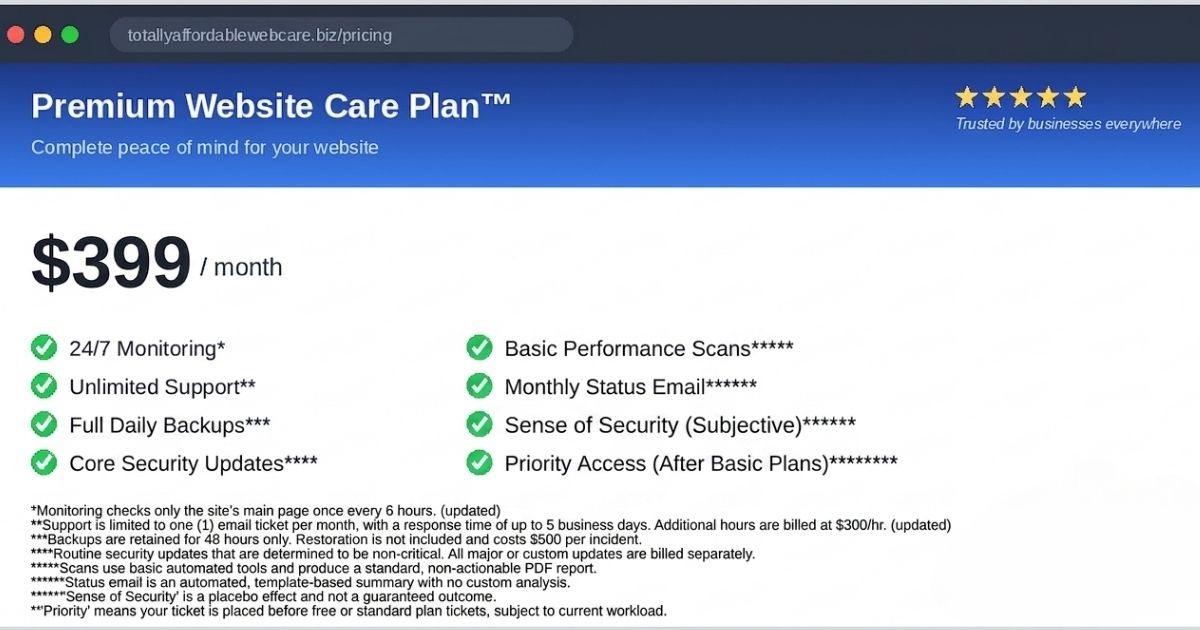
What counts as included. This is where quotes stop being comparable. “Unlimited updates” from one vendor and “unlimited updates” from another can mean wildly different things once you read what qualifies.
What WordPress maintenance costs, and why
Many small business sites run on WordPress, and it is a big reason the price range on this service is so wide.
A WordPress site is the core software, a theme and however many plugins got added over the years. Each of those updates on its own schedule. Updates fix security holes, so skipping them is how sites get compromised. Running them is how sites break, because a plugin update can conflict with the theme or with another plugin and take down a page or a form.
That means someone has to run the updates, look at the site afterward and fix what moved. Every month. That is real recurring labor and a WordPress care plan is priced to cover it. If you are on WordPress and paying at the low end of what you have been quoted, check whether updates are actually included or whether they are billed when something breaks.
I build static sites, which have no plugins, no database and no admin login to compromise. That entire category of monthly work does not exist, which is most of why my number is what it is. It also means moving off WordPress changes what maintenance costs you, permanently.
What a plan should say in writing
Website maintenance plans, packages and care plans are all the same product under different names. They are priced by tier almost everywhere. Bronze, silver, gold. Whatever the tier is called, the maintenance agreement behind it is where the actual terms live.
Before you sign one, get answers to these:
- How many content updates per month or quarter, stated as a number.
- What counts as a content update and what gets quoted separately.
- How long a routine request takes to get done.
- What happens when you go over the included amount.
- Whether the price changes after the first year.
- Who is listed as the owner of the domain registration.
That last one is not a maintenance question and it is the one worth asking first. If the answer is anything other than your business, the rest of the plan is being negotiated from a weak position.
Here is mine, so you have something to hold the answers against. Ten small updates per quarter. A small update is a text change, a phone number or address or hours change, swapping photos or documents or a small addition to a page that already exists. New pages, a new layout, changes to how forms work, copywriting and search engine optimization are quoted separately before I start. A routine update gets done within 2 business days. Go over the ten in a quarter and the extra work gets quoted before I touch anything. The price stays the same after the first year. Any increase after that comes with 3 months notice. The domain is registered to you.
What happens without it
Nothing, for a while. That is the part that makes maintenance easy to skip.
Then a certificate expires and Chrome puts a warning page in front of your site before anyone notices. Or a plugin update runs overnight and the contact form silently stops delivering, and every inquiry after that goes nowhere until somebody notices. Or the site goes down on a Saturday and comes back Monday and you never find out it happened.
None of those cost anything to fix on their own. The cost is time: leads that stopped arriving before anyone noticed the cause.
Comparing two quotes
Whether it’s a competing quote or your own current invoice, run it against the six items above. For each one, find where the document says it is covered. Or doesn’t. If half of them are not mentioned, the number in front of you is not covering them.
Ask about leaving, too. A plan that lets you walk away with your domain, your content and a working copy of your site is worth paying for. If a provider cannot answer that clearly, keep asking until they do.
If you would rather I looked at it than sort through the fine print yourself, send me the URL and I will tell you what your site is running on and what it needs.
Share this article